Pioneer Hall, also known as the old
rock church, is located at 1140 West
7800 South and was built in 1867.
This historic sandstone building was
originally used as a meetinghouse for
Mormon pioneers. In 1937 the Archibald
Gardner Camp of the Daughters of Utah
Pioneers restored the building and renamed
it “Pioneer Hall.” It has been
used as a dance hall, social center and
a house of worship ever since.

A little piece of history about the settlers of West Jordan.
by Becky Bartholomew
History Blazer, November 1995
In the past two decades Salt Lake Valley's West Side has come into its own, with booming population and economic growth. Yet few people know moving "over Jordan" is a valley tradition that began with "Archie" Gardner and his gristmill.
Canadians Archibald and Margaret Livingston Gardner were not the first couple to cross the Jordan River and settle along Bingham Creek. But their arrival changed the future of "West Jordan," which then comprised everything west of the Jordan River, ranging from Point of the Mountain to the Great Salt Lake.
Archie had built his first flour mill at age 17 plus two other mills in Canada before joining the Mormons. Arriving in Utah in 1847, he quickly obtained rights to Warm Springs and attempted to install a mill there. The water volume proved insufficient, so he moved his machinery to Mill Creek and later claimed to have sawed the first lumber in the new Mormon community.
But Mill Creek "dried up" (according to his brother Robert), so in 1849 the Gardner brothers dismantled the mill and carried it across the Jordan River to Bingham Creek, where four or five families had already "moved over" and were attempting to farm despite the Oquirrh Range's shortage of year-round water courses.
The Gardners and their crew immediately set to digging a 2.5-mile millrace for their planned sawmill and gristmill. The channel would be enlarged time and again as an important irrigation canal. They had to construct a low dam at approximately 90th South to raise the river to a level that would feed the canal. The millrace alone cost $5,000, and they financed the entire enterprise themselves.
The Gardners built well. Many years later a grandson helped to tear down one of these pioneer mills with grandfather Archie looking on. The young laborers quickly learned that early-type mills were built not with nails but with mortises and pins that tightened under use until there was "hardly a quiver when running." The demolition crew was stymied until Archie, smiling broadly, instructed them to "start at the key corner where the last brace...was located." Wrote the grandson, "When that was found, all was easy."
Gardner Mill inspired a cluster of small industries, including blacksmith shops, logging and hauling operations, woolen and carding mills, a tannery, several stores, a shoe shop, and later a broom factory. Each employed more settlers, entrenching the Gardner Mill as hub of the west side's first industrial center.
As for Archibald and Robert Gardner, their families grew along with their modest business empire. Archie would eventually boast 11 wives and 48 children and build a total of 35 mills in his lifetime. A descendant wrote that Archie's "real pleasure" was to construct the mills, turning them over to others to operate. On occasion he would almost give a mill away so as to raise capital for yet another. For a time Archie sought to make Spanish Fork his primary home, but this ambition ended when Brigham Young called him to be bishop of the West Jordan Ward. Archie served as Jordan's chief church and civic leader for more than three decades.
Poor brother Robert, on the other hand, learned that "settling down to any kind of labor in a 'Mormon' life was very uncertain." He was just beginning to enjoy the fruits of the Jordan mill when he was called on a mission to Canada. He returned, rebuilt the Mill Creek mill, and was once again becoming a man of substance when he was asked to colonize Utah's Dixie. He never thought to reject a church calling. Apparently his frontier experience had taught him, with many other Utahns of his generation, to subordinate individual ambition to the community welfare.
Sources: James H. Gardner, "Archibald Gardner, the Miller," in Kate B. Carter, Heartthrobs of the West, vol. 3 (Salt Lake City: Daughters of Utah Pioneers, 1948); B. S. Furse, ed., A History of West Jordan (Salt Lake City: City of West Jordan, 1995); "Journal and Diary of Robert Gardner" in Carter, Heartthrobs, vol. 10, (Salt Lake City: Daughters of the Utah Pioneers, 1951).

From the Deseret News of August 14, 1867
"On Sunday morning President Brigham Young with Elders John Taylor, Wilford Woodruff, George A. Smith and George Q. Cannon, of the Twelve, Bishops E. Hunter and John Sharp, Elders H. S. Eldredge, Joseph F. Smith, E. Stevenson and others, traveled to West Jordan Ward to attend the dedication of the new Meeting House there.
"...After meeting, the carriages being ready, the President and company bade goodbye to Bishop Gardner and the Saints there, and returned to the city, by the road on the west side of the river; a mounted escort accompanying for several miles. An interesting story is attached to this little rock church. In 1859 Archibald Gardner was ordained bishop of West Jordan Ward, then numbering about 600 members, and it was he who planned the sturdy building. After many difficulties because of crude tools, the cornerstone was laid May 15th, 1861. Many men worked for nothing; others were paid with produce. Red sandstone for the walls was hauled by ox, horse and mule teams from a quarry near the Oquirrh Range, and the granite trim came from Little Cottonwood Canyon. When the three-foot-thick walls had been erected and the floor laid, no more funds were available, so work came to a standstill.
"Finally, three military men-Charles D. Haun, Samuel Bateman and William Turner-came to the rescue. They planned a military ball to obtain the needed funds. All military men in the Valley were invited as well as Brigham Young, the Apostles and other Church officials. The affair was a great success, the army officers bringing along an army canvas to cover the little church while the grand ball went on below. At a dollar a ticket, enough money was raised to finish the building. On the day of the dedication, President Young found that the grateful Saints had erected nearby a small house where he and his officers could rest during the celebration."


Interior restored church, now used for receptions and parties.

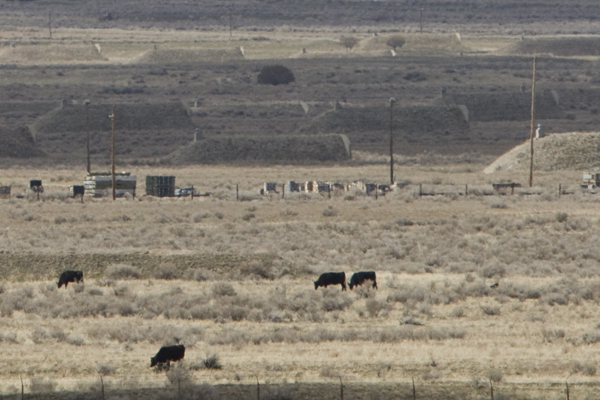


 The Deseret Chemical Depot Incinerator.


