Monday, April 6, 2015

Week 10: Agriculture

West Jordan, Utah


This is the view from my back yard. Although my house is in a suburban area, within a mile of multiple fast food establishments, a hospital, a shopping center, and several churches, the lots in my subdivision are each at least 1/2 acre. My neighbors have an acre and have a small "farm". Here are their chickens grazing.
Displaying 20150406_191338.jpg


 Here are the chickens closer to the coop. Many suburban Utahans keep chickens as a hobby for fresh eggs and for meat. There is even a Facebook group for backyard chicken keepers. 


This is the neighbor's mule. He is very friendly. They use him as a pack animal and let the children ride him. 


Here is the neighbors Appaloosa horse. They recently sold their third horse. They also have a dog. 


This last photo I took just outside my chiropractors office right in the middle of the downtown area (for those familiar with the area, 9000 South and 1600 West, Salt Lake City). Surrounded by 3 story office buildings on 3 sides and the houses in the pictures on the fourth side, this horse has a lovely pasture with plenty of room to roam. 


Even in the city/suburbs, Utahans seem to find a way to keep rural life alive. 


Friday, April 3, 2015

Week 9: People, Migration, Minorities and Religions

Within 3 miles of my house in West Jordan, Utah there are many churches of different denominations. This is very different from a year ago when I lived in Lindon, Utah in Utah County and had to travel over 15 miles to get to a church of any denomination other than Latter Day Saint. I attribute this to the diversity of population and culture in the Salt Lake Valley due to migration and change, especially over the last decade. All of the churches below are within walking distance of my home.


Kingdom Hall of Jehovah's Witnesses


Hope Evangelical Lutheran Church


Seventh Day Adventist Church


St. Joseph the Worker Catholic Church


Latter Day Saint Temple


Published July 24, 2005 2:27 am
On this day, 158 years ago, Brigham Young and his band of pioneers arrived in the Salt Lake Valley, starting a migration that quickly turned Utah into a Mormon-dominated desert realm.
That domination - at least in terms of raw numbers - appears to be nearing its end.Within the next three years, the Mormon share of Utah's population is expected to hit its lowest level since The Church of Jesus Christ of Latter-day Saints started keeping membership numbers. And if current trends continue, LDS residents no longer will constitute a majority by 2030.
These projections are based on normally secret membership counts the LDS Church voluntarily hands over to Utah's Office of Planning and Budget, under what it assumed was a binding confidentiality agreement. The state planning office uses the county-by-county numbers to help estimate future population growth.
Through a public records request, The Salt Lake Tribuneobtained the data from 1989 to 2004. State employees believe the LDS Church has provided the records since at least the 1960s but could retrieve only the numbers for 15 years and found no such confidentiality agreement.
Still, these 15 years are enough to identify a historic transformation in the makeup of Utah's ever-growing population.
Stated simply: "Utah is essentially becoming more like the nation," said Robert Spendlove, the planning office's lead demographer.
Slow shift: The religious shift is likely to alter the civic discourse, but that doesn't mean Utah's LDS-dominated culture or conservative politics will dramatically change anytime soon. Rather, academics say, it will morph over time as non-Mormon births and move-ins continue to whittle away at the percentage of Utahns who are LDS.
As University of Utah sociologist Theresa Martinez said: "The core LDS population will always be a force here. In your lifetime, I am sure it is not going to change that much. It will probably be more diverse but the power structures will probably remain the same."
The often cited claim that Utah is 70 percent Mormon is not true - and hasn't been true for more than a decade, according to the church numbers. While continuing to grow in actual members, the LDS share of the state population showed a slow but constant decline every year from 1989 to 2004.
According to the 2004 count, Utah is now 62.4 percent LDS with every county showing a decrease.
LDS Church officials declined interviews. But they issued a statement in response to questions submitted by The Tribune:"The church has always extended a hand of friendship and fellowship to those of other faiths, and will continue to do so."
The LDS Church said its count comprises "all members" - including children in LDS families under age 8, when most Mormons are baptized, and nonpracticing members.
Professor Tim Heaton, who studies LDS demographics for church-owned Brigham Young University, says the county numbers probably come from church membership rolls, and that between half and one-third of those people are not active in the faith. If that's true, then, at most, 41.6 percent of Utahns are church-going Mormons.
Broken down, the numbers spotlight trends The Tribune will explore in articles today, Monday and Tuesday:
l On the county level, the LDS Church has consolidated congregations in some affluent Salt Lake County neighborhoods after young families relocated to the big, and more affordable, homes in northern Utah County.
l Washington County is growing at the state's most rapid pace and the LDS Church can't keep up with the need for new meeting places. Still, the percent of residents who are Mormon has fallen below that of the state.
l Even in the least LDS county, it is easier for Mormons to find a sense of community than it is for non-Mormons in the most LDS county.
l Statistics from other sources show the LDS growth worldwide has cooled. Official church membership numbers in some key countries are much higher than the LDS population identified by census counts.
Utah's ongoing religious diversification has little to do with the LDS Church or its teachings, but rather is a reflection of the economy, according to Pam Perlich of the University of Utah's Bureau of Economic and Business Research. Perlich sits on the committee that projects state population growth, in part with the help of these LDS numbers. She also reviewed The Tribune'sanalysis for accuracy.
"When economic growth goes up, minority population goes up, and this is kind of a code word for non-Mormons," she said.
Utah saw a similar trend in the early 1900s with the mining boom, but once the mines became unprofitable, workers left and the LDS percentage rose again. Steady economic growth through the 1990s, with a slight hiccup a few years ago, has shifted the main reason people move to Utah from religion to jobs.
Immigrants from Mexico, who are not generally LDS and tend to have large families, have greatly influenced this ongoing shift, Perlich said. Still, she expects the LDS share to rise again if Utah's economy tanks, because people who have tenuous ties to the Beehive State will most likely flee for better job markets, Perlich said.
Gov. Jon Huntsman Jr. calls the drop in LDS share "a trend that was largely predictable." He expects it to have political ramifications, since most Mormons tend to vote Republican.
"We will become more balanced between Republicans and Democrats eventually," said the GOP governor who has no problem with Democrats gaining more power in one of the nation's most conservative states. "I have always stood for balance in all things."
While the voting bloc remains just as Republican as it has been since the early 1980s, BYU political scientist Kelly Patterson has observed "a small decline" in the percentage of voters who are LDS, according to exit-polling data after elections. He has found that conservative voters always have comprised 55 percent to 60 percent of the electorate, while the LDS voters declined from 72 percent in the 1984 presidential election to 67 percent in 2004.
Lifestyles and morals: Utah's unchanged GOP bent - along with other ongoing trends attributed to the large LDS population - suggests that many new non-Mormons fit in with the state's lifestyle. Utahns continue to be less likely than the average American to smoke, abuse drugs, die of cancer or give birth as a teenager.
Perlich isn't surprised, saying a non-Mormon is only a person whose religious beliefs differ from that of the LDS Church and that includes people with morals similar to the average Mormon.
"The non-Mormon population is not monolithic," she said. "It has a great diversity within itself."
Huntsman says the decline in Utah's homogeneous population is an outgrowth of the LDS Church's success in attracting converts in other countries.
"The LDS Church becomes more internationalized, the state of Utah becomes more internationalized," Huntsman said. "We become more attractive to all people, not just people from one particular religion, and I think that will continue to be the trend going forward."
Demographers for the state, University of Utah and BYU agree that at least one statistic helps explain the decline in Mormon percentage: the fertility rate.
In the 1960s, Utah women of childbearing age averaged 4.3 children, far surpassing the national average. That number is down to 2.6 children per woman - only a half-percent above the norm.
Growing subcultures: Deciphering how Utah's shifting demographics will change neighborhoods is hard to quantify, BYU's Heaton said. The new religious diversity may spur recharged debates in public schools over long-standing issues such as sex education and the performance of religious songs and prayer at graduation. He also believes the rate of new LDS baptisms will slow.
"As the subcultures of Utah gain strength in numbers, newcomers don't have to turn to the LDS Church to find a sense of community," he said.
But the average Utah Mormon will experience this religious transformation in a more fundamental way, said Heaton, who believes he already has felt it in his booming Springville community.
"When I moved in, I knew everybody in the neighborhood and to some degree their attachment to Mormonism," Heaton said. "But now it is harder to get a sense of your neighborhood."
While Utah's religious diversification is significant, it should not be overstated, Perlich said.
Mormons still make up a "commanding majority in many parts of the state" and will for decades, she said. Even after dropping below the 50 percent mark around 2030, the LDS Church will remain a dominant presence and will define Utah's reputation throughout the world.
"For as long as that church is vibrant," she said, "Utah culture will always be tied to it."

Thursday, April 2, 2015

Week 8: Early Mining in Utah


Rio Tinto Kennecott Copper Mine has been a fixture in the Salt Lake Valley for more than 109 years. It is the largest private economic driver in Utah. No other private sector operation has generated more production, exports, income and employment than Kennecott.


Currently, the power plant produces 175 megawatts (MW) using four boilers powered by either coal or natural gas.

Tailings pond number 2 Dam
Bingham Canyon copper mine (RickM2007) Tags: rock metal utah mine hole deep grade canyon copper trucks elevation load dig coppermine haul tons kennecott bingham utahmine massivemine

Photo taken by my uncle John Coyne who works at the mine and drives one of the trucks.

MomsTrip_090510.122351 (steinersapien) Tags: dumptruck schoolbus coppermine kennecott momstrip
These trucks are approximately 2 stories tall. Photo courtesy John Coyne. 


Week 7: Early Permanent Settlements


Pioneer State Trail Park is located in beautiful Salt Lake City, Utah.  Part of the park is designated as Old Deseret Village and it is here you will find the old Forest Farmhouse of Brigham Young where he had a dairy and experiment farm. This old house is said to be haunted with the spirits of those who lived there long ago. Built in the late 1800s, this two story house with a wrap around porch, even had a ballroom on the second floor.


Often you will find people dressed in period costumes explaining and sharing the stories of those early days at the farm. There is even a stagecoach ride pulled by a beautiful team of horses and driven by a real cowboy. During the ride you will pass the bowery a thatched roofed, open-air structure.  This was a replica of the shelters used by the pioneers for protection of early Saints while attending church or other functions on Temple Square. This was the place to meet while they were building the tabernacle


When the Saints let by Brigham Young crossed the Wasatch Range of the Rockies through the mouth of Emigration Canyon, they gazed at the New Zion, soon to become Salt Lake City.  It is recorded that Young said, “This is the right place.”  One woman who walked barefoot from Illinois every step of the way, put on the slippers she had carried the entire trek so she could enter Zion with dignity. At this spot they built a This is the Place Monument, a white stone obelisk, honoring the 1847 settlement.


On the 100th anniversary, a new and large monument was erected just down the hill from the original spot. This new monument was designed by the grandson of Brigham Young, sculptor, Mahonri M Young. There are twenty four individuals on the new monument honoring the leaders who settled the Salt Lake Valley. The figures stop the central portion are Brigham Young in the center,  Heber Kimball, and Wilford Woodruff, all prominent leaders in the early days of the Mormon Church. This monument was erected by my great grandfather, Philip Bott. (see info at http://www.bottandsons.com/about.html)


Saturday, February 28, 2015

Week 6: Lands and Territoriality

Tooele Army Depot has been an active army base since the early 1940s. The 23,732-acre site is located in northeastern Tooele County, Utah, about 35 miles southwest of Salt Lake City.

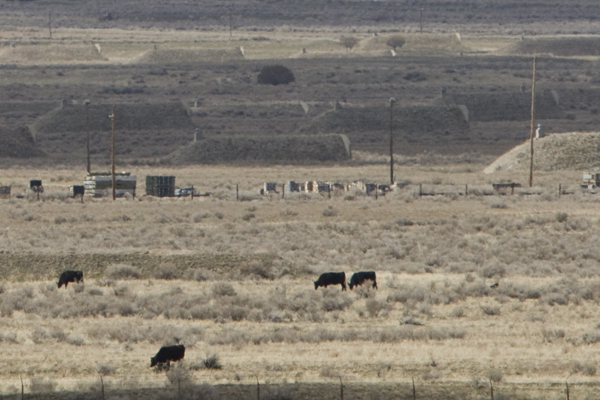
A field of storage igloos where chemical weapons are stored.

History: For over 50 years, Tooele Army Depot has committed itself to supporting the soldier in times of peace and war. In its infancy, it served this nation when the free world struggled and witnessed the final victory during World War II. A few years later, it helped sustain our troops, and those of the United Nations, in the stemming of the onslaught of communism upon the country of Korea. Shortly after its 25th anniversary, Tooele Army Depot saw itself supporting our military men and women who were called upon to serve during the Vietnam War. More recently, the depot answered the call twice again to provide our troops the means of victory in the country of Panama and the harsh deserts of the Persian Gulf during operations of Desert Shield/Desert Storm. (military.com)

Cows grazing not far from the igloos.


Government property.

This photo shows the empty above-ground storage igloos that once stored chemical munitions at the Deseret Chemical Depot in Stockton on Wednesday, January 18, 2012.   Workers began processing the Deseret Chemical Depot's last remaining chemical agent, Lewisite through the Area 10 Liquid Incinerator,  following the disposal of the final mustard agent-filled projectiles. (Laura Seitz, Deseret News)

This photo shows the empty above-ground storage igloos that once stored chemical munitions at the Deseret Chemical Depot in Stockton. Destruction of the chemical munitions was completed from 1996 to 2012.
The chemical weapons incinerator at Deseret Chemical Depot outside of Tooele, Utah,  Mar. 9, 2005. (Tom Smart, Deseret News)The Deseret Chemical Depot Incinerator.


 The Depot incorporates a number of institutional and land use controls to ensure safety at the site. They include signage, fencing, deed restrictions, controlled access through manned guard gates, secondary gates controlled by ammunition demilitarization personnel, and required inspections of the Industrial Waste Lagoon and ditches. A groundwater management zone extends beyond the mapped area of groundwater contamination, so that exposures to contaminants in the plume will not take place. Annual inspections evaluate the effectiveness of the land use control system.

BRANCH:                   Army
LOCATION:               Tooele County, Tooele, Utah
FACILITIES:
            SIZE:                    23,509 acres
            BUILDINGS:        1,167
            IGLOOS:               902
            STORAGE CAPACITY:            2,483,000 sq ft
                Explosive:                                 1,951,000 sq ft
                Inert:                                       532,000 sq ft
                Percentage Utilized:                 85%
 
ECONOMIC IMPACT (FY99): 
            OPERATING BUDGET:            $61,289,000
            PAYROLL:                                 $30,084,000
            LOCAL PROCUREMENT:       $     800,000
 
EMPLOYMENT LEVEL:
            CIVILIAN:                                    501
            MILITARY:                                  2
            CIVILIAN TENANTS:                48
            MILITARY TENANTS:               24
(statistics: globalsecurity.org)

Monday, February 16, 2015

Week 5: Explorers and Permanent Settlers


Pioneer Hall, also known as the old rock church, is located at 1140 West 7800 South and was built in 1867. This historic sandstone building was originally used as a meetinghouse for Mormon pioneers. In 1937 the Archibald Gardner Camp of the Daughters of Utah Pioneers restored the building and renamed it “Pioneer Hall.” It has been used as a dance hall, social center and a house of worship ever since.

Image
A little piece of history about the settlers of West Jordan.
by Becky Bartholomew
History Blazer, November 1995
In the past two decades Salt Lake Valley's West Side has come into its own, with booming population and economic growth. Yet few people know moving "over Jordan" is a valley tradition that began with "Archie" Gardner and his gristmill.
Canadians Archibald and Margaret Livingston Gardner were not the first couple to cross the Jordan River and settle along Bingham Creek. But their arrival changed the future of "West Jordan," which then comprised everything west of the Jordan River, ranging from Point of the Mountain to the Great Salt Lake.
Archie had built his first flour mill at age 17 plus two other mills in Canada before joining the Mormons. Arriving in Utah in 1847, he quickly obtained rights to Warm Springs and attempted to install a mill there. The water volume proved insufficient, so he moved his machinery to Mill Creek and later claimed to have sawed the first lumber in the new Mormon community.
But Mill Creek "dried up" (according to his brother Robert), so in 1849 the Gardner brothers dismantled the mill and carried it across the Jordan River to Bingham Creek, where four or five families had already "moved over" and were attempting to farm despite the Oquirrh Range's shortage of year-round water courses.
The Gardners and their crew immediately set to digging a 2.5-mile millrace for their planned sawmill and gristmill. The channel would be enlarged time and again as an important irrigation canal. They had to construct a low dam at approximately 90th South to raise the river to a level that would feed the canal. The millrace alone cost $5,000, and they financed the entire enterprise themselves.
The Gardners built well. Many years later a grandson helped to tear down one of these pioneer mills with grandfather Archie looking on. The young laborers quickly learned that early-type mills were built not with nails but with mortises and pins that tightened under use until there was "hardly a quiver when running." The demolition crew was stymied until Archie, smiling broadly, instructed them to "start at the key corner where the last brace...was located." Wrote the grandson, "When that was found, all was easy."
Gardner Mill inspired a cluster of small industries, including blacksmith shops, logging and hauling operations, woolen and carding mills, a tannery, several stores, a shoe shop, and later a broom factory. Each employed more settlers, entrenching the Gardner Mill as hub of the west side's first industrial center.
As for Archibald and Robert Gardner, their families grew along with their modest business empire. Archie would eventually boast 11 wives and 48 children and build a total of 35 mills in his lifetime. A descendant wrote that Archie's "real pleasure" was to construct the mills, turning them over to others to operate. On occasion he would almost give a mill away so as to raise capital for yet another. For a time Archie sought to make Spanish Fork his primary home, but this ambition ended when Brigham Young called him to be bishop of the West Jordan Ward.  Archie served as Jordan's chief church and civic leader for more than three decades.
Poor brother Robert, on the other hand, learned that "settling down to any kind of labor in a 'Mormon' life was very uncertain." He was just beginning to enjoy the fruits of the Jordan mill when he was called on a mission to Canada. He returned, rebuilt the Mill Creek mill, and was once again becoming a man of substance when he was asked to colonize Utah's Dixie. He never thought to reject a church calling. Apparently his frontier experience had taught him, with many other Utahns of his generation, to subordinate individual ambition to the community welfare.
Sources: James H. Gardner, "Archibald Gardner, the Miller," in Kate B. Carter, Heartthrobs of the West, vol. 3 (Salt Lake City: Daughters of Utah Pioneers, 1948); B. S. Furse, ed., A History of West Jordan (Salt Lake City: City of West Jordan, 1995); "Journal and Diary of Robert Gardner" in Carter, Heartthrobs, vol. 10, (Salt Lake City: Daughters of the Utah Pioneers, 1951).


From the Deseret News of August 14, 1867
"On Sunday morning President Brigham Young with Elders John Taylor, Wilford Woodruff, George A. Smith and George Q. Cannon, of the Twelve, Bishops E. Hunter and John Sharp, Elders H. S. Eldredge, Joseph F. Smith, E. Stevenson and others, traveled to West Jordan Ward to attend the dedication of the new Meeting House there.
"...After meeting, the carriages being ready, the President and company bade goodbye to Bishop Gardner and the Saints there, and returned to the city, by the road on the west side of the river; a mounted escort accompanying for several miles. An interesting story is attached to this little rock church. In 1859 Archibald Gardner was ordained bishop of West Jordan Ward, then numbering about 600 members, and it was he who planned the sturdy building. After many difficulties because of crude tools, the cornerstone was laid May 15th, 1861. Many men worked for nothing; others were paid with produce. Red sandstone for the walls was hauled by ox, horse and mule teams from a quarry near the Oquirrh Range, and the granite trim came from Little Cottonwood Canyon. When the three-foot-thick walls had been erected and the floor laid, no more funds were available, so work came to a standstill.
"Finally, three military men-Charles D. Haun, Samuel Bateman and William Turner-came to the rescue. They planned a military ball to obtain the needed funds. All military men in the Valley were invited as well as Brigham Young, the Apostles and other Church officials. The affair was a great success, the army officers bringing along an army canvas to cover the little church while the grand ball went on below. At a dollar a ticket, enough money was raised to finish the building. On the day of the dedication, President Young found that the grateful Saints had erected nearby a small house where he and his officers could rest during the celebration."


Image


Interior restored church, now used for receptions and parties.

Wednesday, February 11, 2015

Week 4: Water Resources

The Jordan River drains a 3,805 square mile basin found in North central Utah, and includes Utah Lake and the Provo River. The Great Salt Lake is the eventual recipient of water in the north-flowing Jordan River.The lowest elevation in the watershed, at the outlet to the Great Salt Lake, typically has an elevation of approximately 4,200 feet depending on precipitation and water availability. The basin is bounded on the east by the Wasatch Range and on the west by the Oquirrh Mountains.  The Wasatch Range to the east of the Jordan River has the highest elevations in the Watershed reaching levels over 11,000 feet. The Oquirrh Mountains to the west of the Jordan River, reach elevations of over 9,000 feet. The land surface between these ranges consists of a series of benches, each of which slope gradually away from the mountains and drop sharply to the next bench.

Below are photos from the Jordan River Parkway.

Jordan River near Riverton - A floodplain with wet meadows and riparian habitat.  On the eastern side seeps keep the squawbush and chokecherry areas wet year-round.  This is great bird habitat! 


This beautiful photo shows the dense foliage at the riverbed and the Oquirrh mountains in the background.


Another flood plain, great habitat.


One of the many canals from the Jordan.


Blury, but I love the colors in winter along the parkway.